 Foldque
How to Analyze Math Mistakes
In any rigorous academic curriculum, whether you are preparing for university entrance exams, international standardized tests, or simply aiming to improve your high school math grades, math often demands the most time and strategic effort. Many students solve hundreds of questions and take multiple practice exams weekly, yet fail to see the improvement they desire. The question you should ask yourself is not "How many questions did I solve?", but rather "What did I learn from the questions I got wrong?" In this guide, we will explore step-by-step how to transform a superficial check of math mistakes into a powerful, personalized learning tool.

Table of Contents
- 1. What Is Math Mistake Analysis?
- 2. Why Are Your Math Results Not Improving?
- 3. The Main Types of Math Mistakes
- 4. How to Analyze a Missed Question
- 5. Create a Math Mistake Analysis Table
- 6. What Should You Do After Identifying the Mistake?
- 7. Build a Practical Review Schedule
- 8. Create a Weekly Mistake-Analysis Routine
- 9. Analyze and Review Math Questions with Foldque
- 10. Common Mistake-Analysis Errors
- 11. Frequently Asked Questions
1. What Is Math Mistake Analysis?
Mistake analysis is not just about counting the number of correct and incorrect answers after a test, calculating your score, and closing the book. True analysis is the process of pinpointing exactly where and why a mistake occurred during the problem-solving process.
Two students might both get five questions wrong on a math test, but their underlying weaknesses could be entirely different.
One student might lack fundamental knowledge of the topic, while the other might struggle with calculation errors, a lack of focus, poor strategy selection, or time management. Therefore, mistake analysis is about finding the root cause, developing a specific solution for that weakness, and creating a personalized roadmap to prevent the same error from happening again.
2. Why Are Your Math Results Not Improving?
When math scores remain stagnant despite hours of studying and solving hundreds of questions, the issue usually stems from strategic flaws in the study method. Common reasons include:
- Solving too many questions without reviewing mistakes: Prioritizing quantity over quality leads to bringing the same weaknesses into new tests.
- Assuming you've learned it just by reading the solution: Believing you understand a solution is very different from being able to construct that solution yourself from scratch.
- Treating every mistake as a knowledge gap: Relearning an entire chapter just because you dropped a minus sign is a massive waste of time.
- Tracking progress only through final scores: Scores can fluctuate; what truly matters is identifying the specific topics where you consistently lose points.
- Repeating similar errors: If mistakes aren't systematically corrected, the brain tends to default to the same flawed calculation habits.
- Focusing on the final answer rather than the method: Skipping over how the question prompt was interpreted to just look at the final number hinders real growth.
- Losing missed questions in your photo gallery or chats: Failing to easily access a challenging question from a month ago means you've likely forgotten it completely.
- Skipping regular reviews: A newly learned solution method will fade from memory quickly if it isn't practiced regularly.
3. The Main Types of Math Mistakes
To evaluate a missed question properly, you must determine which category the error falls into. Math mistakes generally stem from the following root causes:
A. Knowledge gap
This occurs when you simply do not know or cannot recall the formula, rule, or core concept required for the question. If you stare at a problem and have no idea where to even begin, this is a knowledge gap.
This is common in topics like geometry theorems, specific probability rules, or foundational algebra. The only fix here is to revisit the core material.
B. Conceptual misunderstanding
In this scenario, you think you understand the topic, but you've drawn incorrect relationships between concepts.
For example, assuming that "every integer is a rational number" is false when setting up an equation is a conceptual misunderstanding. This is different from a knowledge gap; here, you proceed with confidence, but your foundational logic is flawed, leading to consistent errors in similar problem types.
C. Calculation error
This category covers mistakes in basic mathematical operations. However, you shouldn't dismiss every calculation error as mere "carelessness."
- Sign errors: Incorrectly multiplying a negative by a negative.
- Basic arithmetic and simplification errors: Momentary lapses in simple addition or division.
- Parenthesis errors: Failing to distribute an operation to all terms inside a bracket.
- Equation transfer errors: Forgetting to change a sign when moving a term across the equals sign.
Frequently repeated calculation errors indicate a problem with your foundational calculation habits or a lack of an effective self-checking mechanism.
D. Misreading the question
Math exams often test reading comprehension and the ability to translate words into mathematical language. Errors in this category include:
- Missing negative wording in the prompt, such as "Which of the following is NOT..."
- Finding an intermediate result (like solving for 'x') and selecting that from the multiple-choice options, when the question actually asked for '2x+1'.
- Ignoring critical initial conditions, such as "x is a positive integer".
- Translating a long word problem into the wrong mathematical equation.
- Misinterpreting data presented in graphs or tables.
E. Inefficient strategy
Sometimes you are perfectly capable of solving the question, but you choose a method that is so long, complex, or inappropriate that you either get stuck halfway or waste too much time and abandon it. Because time management is crucial in exams, selecting the shortest and most reliable path to the correct answer is just as important as the answer itself.
F. Attention and checking error
True carelessness happens when you fully know the topic, concepts, and operations, but you overlook something due to momentary exam stress. This should not be confused with a knowledge gap. Taking just a few seconds after finishing a problem to ask, "What was asked of me, and what did I find?" can significantly reduce these errors.
G. Time-management problem
This is often a result of exam psychology. Errors manifest in ways such as:
- Stubbornly spending too much time (e.g., 5-6 minutes) on a single question.
- Getting stuck on a difficult question, leading to a loss of morale and focus.
- Rushing through easy questions and making mistakes because time is running out.
- Experiencing mental fatigue in the final section of the exam, causing failures in basic operations.
4. How to Analyze a Missed Question
For every question you get wrong, you should mentally (or on paper) ask yourself these five questions:
- What was the question asking for?
Test whether you fully grasped the prompt and the core data provided. - At what stage did I stop or make a mistake?
Check your steps to pinpoint exactly where the logic or calculation broke down. - What was the real cause of the mistake?
Was it a knowledge gap, a calculation error, or a misinterpretation? Identify the cause clearly. - What step did I miss that the correct solution shows?
Find that "aha!" moment when reviewing the correct method. - What will I do to prevent this error from recurring?
Determine a new strategy for when you face a similar problem in the future.
Superficial explanations like "I got it wrong because I wasn't paying attention" are not enough to drive improvement. Be honest with yourself and formulate specific, detailed analyses:
- "I didn't carry over the negative sign when distributing the parenthesis in the second line."
- "I set up the ratio incorrectly between the part and the whole in the word problem."
- "I ignored the condition that the domain must be 'positive integers'."
- "I wasted time by choosing to write out a long equation instead of testing the given values."
- "I missed the phrase 'at least' in the prompt and chose the first valid result I found."
5. Create a Math Mistake Analysis Table
To track your mistakes systematically, you can create a digital or physical analysis table. This helps you see if your errors are concentrated in specific areas (e.g., consistently making calculation errors in word problems).
| Date | Source / Exam | Subject & Topic | Question Type | Cause of Error | Where I Went Wrong | Correct Approach | Next Review | Review Result |
|---|---|---|---|---|---|---|---|---|
| 2026-07-14 | Practice Exam 3 | Math - Word Problems | Percentage Problem | Incorrect Equation | Translated text into wrong equation (Error in part-to-whole logic) | Define variables as 100x from the start and rebuild the ratio relationship | In a few days | Not yet reviewed |
6. What Should You Do After Identifying the Mistake?
The action you take must vary depending on the type of error you've identified:
- If it's a knowledge gap: Quickly return to that specific section of the topic for a brief review. Study the fundamental examples, resolve them, and then return to similar questions in your practice materials.
- If it's a calculation error: Get into the habit of writing your calculation steps more neatly on paper. Avoid doing critical transitions purely in your head. Practice with short drills that involve similar operations.
- If it's an inefficient strategy: Carefully study the alternative solution, whether it's a video or written text. Note down the shorter, more reliable method in your own words. Completely hide the solution and re-solve the question from scratch using that new method.
- If it's a time-management problem: Re-solve the question with a stopwatch. Set a "getting stuck limit" for yourself (e.g., 2 minutes). Develop the habit of moving on without being stubborn, and use a looping technique to return to skipped questions at the end of the exam.
- If it's an attention error: Make a habit of underlining critical phrases in the prompt like "cannot be," "at least," or "integer" (but only underline those key words, not the whole sentence). When you finish solving, do one final check to ensure the result is actually what was asked and that units/signs match.
7. Build a Practical Review Schedule
Analyzing a missed question is not enough on its own; true retention is achieved by returning to that question at later times. However, there is no strict scientific formula that works universally for everyone's review schedule. Learning is personal.
As a starting point, a missed or challenging question can be revisited one day later, a few days later, a week later, and then at a longer interval. These intervals are not rigid rules; they should be fully personalized, shortened, or lengthened based on how successfully you review the question and its difficulty level.
- When reviewing, never just read the solution. Always completely cover the solution and try to re-solve the question from scratch.
- If you get the question wrong again during a review, re-analyze the root cause of the mistake from the beginning.
- For questions you solve correctly and fluently on consecutive reviews, extend the interval before the next review or remove them from your active archive.
- For questions where you still struggle, don't wait too long before reviewing them again.
- Merely remembering that the answer is "Option C" does not mean you've learned the logic of the question; you must be able to construct the solution path yourself.
8. Create a Weekly Mistake-Analysis Routine
To make this process manageable, establish a weekly system that you can consistently follow:
- Post-Exam (Same Day): Do your initial review right after the exam. Check which questions you stumbled on and verify your correct answers.
- Analysis Phase: Categorize your mistakes by type (knowledge gap, calculation error, attention error, etc.). Record the causes in a table or app.
- Archiving: Save the question images and, if you have them, the solution images separately into your digital archive (like Foldque).
- Closing Gaps: Add any identified knowledge gaps to your weekly study schedule.
- Short Reviews: Designate one or two days during the week as "Review Days," where you attempt to solve the questions you saved earlier without looking at the solutions.
- End-of-Week Evaluation: Look at your most frequent error type at the end of the week to determine your strategy for the following week (e.g., "This week on the practice exam, I will be more careful with negative signs").
9. Analyze and Review Math Questions with Foldque
Managing this entire process with physical notebooks, scissors, glue, or photos lost in a gallery can eventually become impossible. Foldque is your personal digital question archive, designed specifically to help you execute this mistake analysis and review cycle practically.
Foldque doesn't identify the cause of your mistakes for you; however, by keeping the question, the solution, and the review process all in one place, it makes it incredibly easy to build a genuine mistake-analysis system.
- You can photograph and save a challenging question from an exam or textbook in seconds.
- Most importantly, you can add the solution image separately for the same question. This ensures you don't accidentally see the answer during review, allowing you to re-solve it from scratch.
- With "Solution Mode," you can draw and write your own solution paths directly over the question image using your finger or a stylus.
- You can organize all saved questions into folders by subject and topic, and filter them using tags like "mistake" or "important."
- You can revisit past questions and generate randomized mini-exams to test your retention.
- The team feature allows you to send tough math questions to your study group and discuss different solution methods together.
- You can track your daily study statistics to see concretely which subjects require more of your focus.

See How Foldque Works
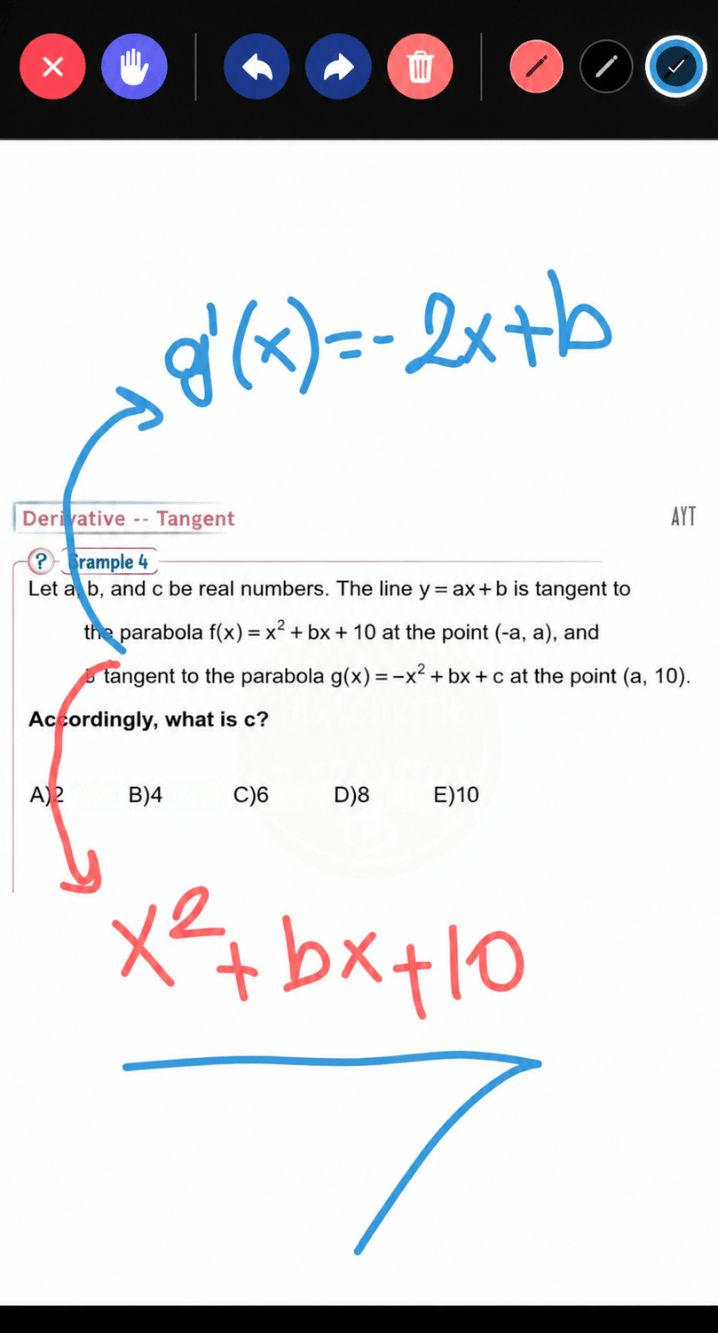 Draw Your Solutions
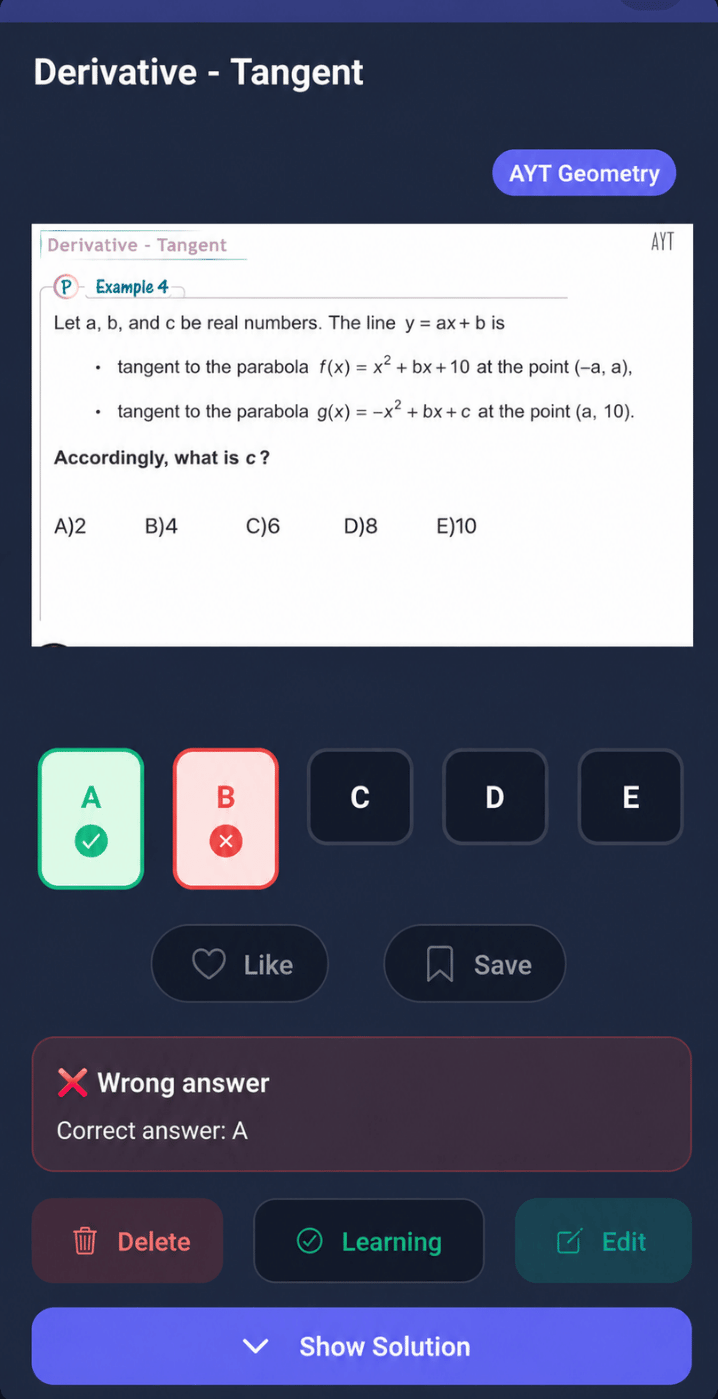 Review Your Mistakes
 Organize by Subject
10. Common Mistake-Analysis Errors
These are the common pitfalls that render mistake analysis ineffective:
- Calling every mistake "carelessness": Using this as a convenient excuse to mask actual knowledge gaps.
- Only watching solution videos: Nodding along to a video is passive learning. Until you solve the question yourself, you haven't learned it.
- Archiving a question without noting the cause of the error: You won't remember why you saved that question a few weeks later.
- Saving too many questions and never reviewing them: Turning your archive into a digital dump. An unreviewed archive is useless.
- Only saving completely wrong questions: Ignoring questions you got right but took 4 minutes to solve, or questions you guessed correctly, limits your growth.
- Revealing the solution too early during review: Looking at the answer the moment you struggle undermines your brain's process of building connections.
- Failing to notice that the same type of error persists for weeks: A direct consequence of not keeping a table or a structured record.
11. Frequently Asked Questions
How do I analyze math mistakes?
You analyze mistakes by identifying the root cause (knowledge gap, calculation error, time issue, etc.), archiving the question and solution separately, and re-solving the question at specific intervals without looking at the solution.
Why are my math results not improving?
Scores remain stagnant if you only solve lots of questions without diving into the root causes of your errors, if you repeat the same mistakes, and if you don't develop alternative methods for questions that consume too much time.
Should every wrong question be recorded?
No, you should only record high-quality questions that teach you something new, reveal a critical flaw in your process, or contain a key concept logic. Saving routine questions with simple arithmetic errors just clutters your archive.
Should I save questions I got right but took a long time?
Absolutely. Standardized math tests are often speed tests. Even if you arrive at the correct answer, if your method was too long, you should note a shorter, more practical solution and add it to your archive.
How do I distinguish between a calculation error and a careless mistake?
A calculation error involves a momentary lapse in mathematical steps (multiplication, division, carrying signs). An attention error involves missing critical phrases in the text like "cannot be" or "minimum," or misinterpreting units (e.g., cm instead of mm).
When should I review missed exam questions?
While it varies based on difficulty and personal preference, it's generally recommended to re-solve them completely blindly 1-2 days later, and then again a week later. You can space this out further based on how well you remember the logic.
Is watching the solution video enough?
No, watching is passive. After watching the solution, you must close the video and solve the problem entirely on your own on a blank piece of paper or via the Foldque app.
Does Foldque provide ready-made math questions?
No, Foldque is not a question bank. It is entirely a personal digital question and solution archive app that you build yourself by photographing questions from your own exams and textbooks.
Do More Than Count Your Mistakes
Use Foldque to save missed, challenging or time-consuming math questions, keep question and solution images separately, review your mistakes and build a personal question archive. You can visit our download page to learn more.
BUILD YOUR MATH QUESTION ARCHIVE