 Foldque
How to Build a Mistake Notebook and Digital Question Archive
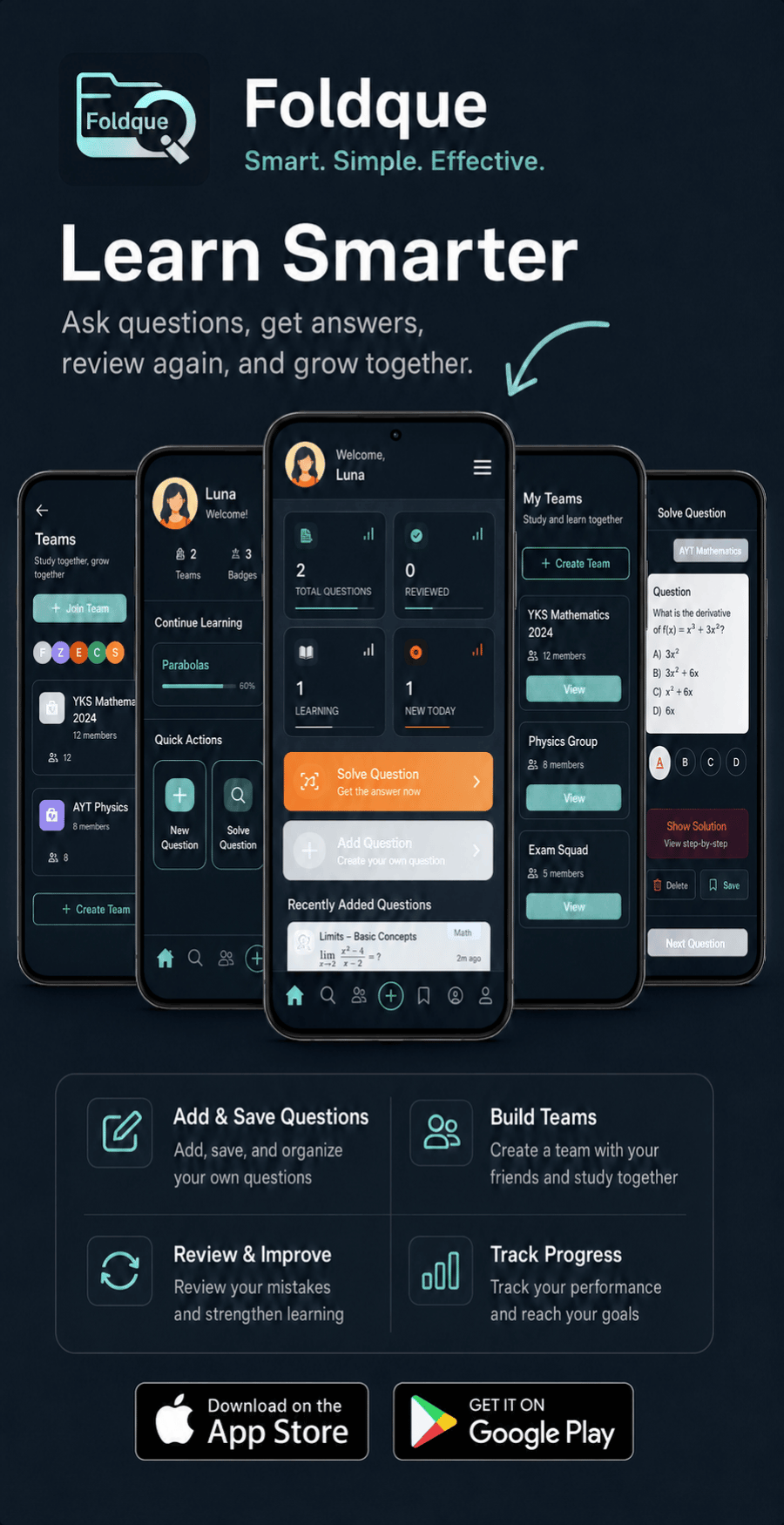
Table of Contents
- 1. What Is a Mistake Notebook and Digital Question Archive?
- 2. Why Should You Return to Challenging Questions?
- 3. Paper Notebook vs. Digital Question Archive
- 4. Which Questions Should You Save?
- 5. Why Keep Question and Solution Images Separately?
- 6. How to Organize Questions by Subject and Topic
- 7. Using a Question Archive for Mathematics and Exam Preparation
- 8. How to Build a Practical Review Schedule
- 9. Common Mistakes When Building a Question Archive
- 10. Question Archives and Skill-Based Learning
- 11. Building a Digital Question and Solution Archive with Foldque
- 12. Frequently Asked Questions
1. What Is a Mistake Notebook and Digital Question Archive?
A mistake notebook has traditionally been a tool where students cut out or write down questions they got wrong in practice tests.
However, with modern educational technology, this concept has evolved into a comprehensive digital question archive. A digital question archive is a personal study system where you systematically store not only incorrect questions, but also ones you couldn't solve, answered correctly by guessing, found too time-consuming, or simply want to review later.
Whether you are preparing for international exams, taking university courses, or focusing on independent study, this system transforms your study sessions into a data-driven process. Solving countless practice questions is not enough; the key is understanding your mistakes and reviewing them regularly.
2. Why Should You Return to Challenging Questions?
In exam preparation, merely solving thousands of questions is not the ultimate goal; learning from your struggles is. Educational research indicates that actively trying to recall information and re-solving questions, rather than passively re-reading notes, can support long-term retention.
Archiving and reviewing a challenging or significant question offers several benefits:
- Identify Weak Topics: You can clearly see which concepts or question types consistently cause you trouble.
- Avoid Repeating Mistakes: Under pressure, students often repeat the same careless errors. Studying an archive interrupts this cycle.
- Efficient Study Time: Instead of wasting time on topics you already master, you focus directly on areas that need improvement.
3. Paper Notebook vs. Digital Question Archive
Keeping a paper notebook can feel rewarding, but as your question pool grows, managing it becomes difficult. A digital archive allows you to easily organize and review hundreds of questions.
| Feature | Paper Notebook | Digital Question Archive |
|---|---|---|
| Adding Questions | Cutting with scissors or writing by hand (slow) | Taking a photo with a camera (in seconds) |
| Organization | Pages get mixed up, hard to add topics later | Easy grouping with unlimited folders and tags |
| Saving Solutions | Written next to the question; visible during review | Solution image saved separately; opened when needed |
| Portability | Creates physical weight | The entire archive travels in your phone |
4. Which Questions Should You Save?
Contrary to popular belief, a personal question archive is not just for questions you got completely wrong. To build a truly effective archive, you should also save the following types of questions:
- Incorrect or unsolved questions: Fundamental gaps where you forgot a formula or concept.
- Correct answers reached by guessing: Dangerous questions where your underlying knowledge is incomplete despite a lucky guess.
- Questions that took too long: Crucial for timed exams where you need to discover faster, more practical methods.
- Useful or elegant solutions: Visionary question types that expand your problem-solving perspective.
- Questions your teacher highlighted: Important examples emphasized during a lecture.
- Questions worth reviewing before an exam: Examples you feel perfectly summarize a difficult topic.
- Similar questions for comparison: Minor details that show the exceptions to a rule.
This way, your archive becomes more than just a mistake notebook; it becomes a personalized library of questions and solutions.
5. Why Keep Question and Solution Images Separately?
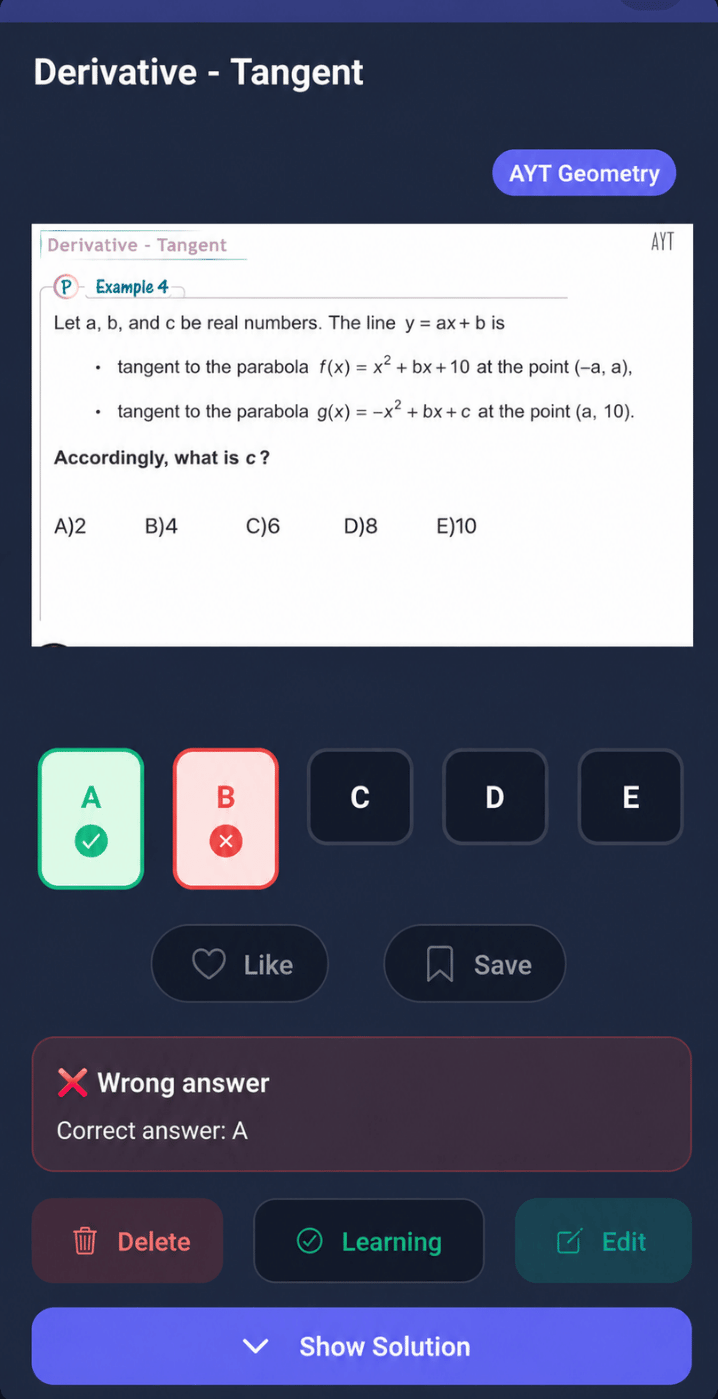
One of the biggest mistakes in traditional methods is keeping the question and its solution on the same piece of paper or in the same photo. If the question and solution share the same image, you might accidentally see the answer while reviewing, which undermines the learning process.
For an effective review, you should first open only the original question image and attempt to solve it. Only after giving your answer should you view the solution image. Comparing your steps with the correct method helps you see your errors clearly. Furthermore, you shouldn't have to get lost in your photo gallery, textbook pages, or chat messages just to find the solution again.
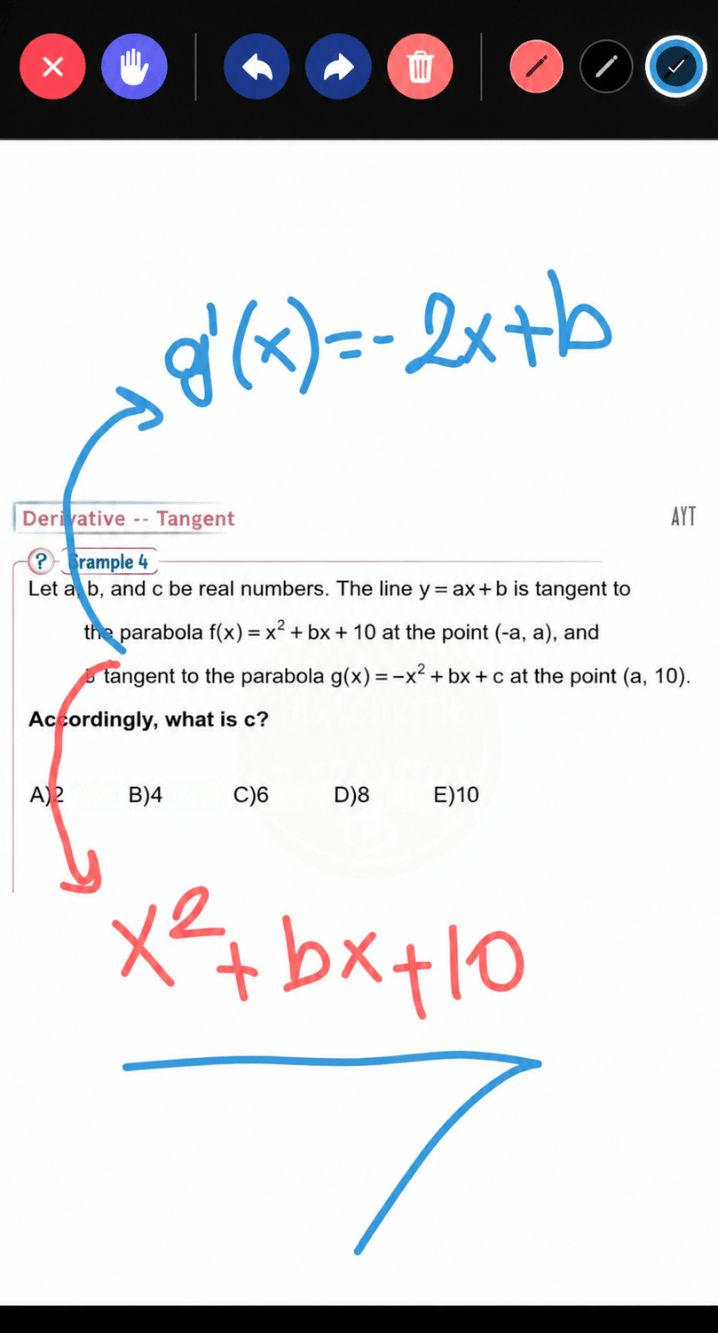
In a good system, you can directly photograph the solution as your instructor writes it on the board, or save a handwritten or drawn solution of your own. Analyzing different solution methods under the same question accelerates your progress.
6. How to Organize Questions by Subject and Topic
A cluttered question archive makes finding what you need impossible. You must establish a logical hierarchy when saving questions:
- Define main folders: Mathematics, Physics, History, Literature, etc.
- Create subfolders: Inside the Mathematics folder, create categories like "Calculus," "Probability," or "Geometry."
- If your app supports it, add tags like difficulty levels or "must review."
7. Using a Question Archive for Mathematics and Exam Preparation
Especially during rigorous academic prep, mathematics scores heavily influence overall rankings. Storing time-consuming algebra or arithmetic problems helps you build speed. For advanced math, archiving challenging questions related to trigonometry, calculus, or analytic geometry can make a huge difference.
When archiving mistakes from practice exams, it is crucial to keep the question and the correct solution together, yet hidden from each other. When you add an unsolved calculus question to your archive, you should revisit it weeks later by answering it before revealing the solution. Only then should you open the solution image to compare your steps.
This systematic approach can be seamlessly applied to university courses and independent study routines, bringing logic and discipline to your workflow.
Furthermore, instead of simply counting how many mistakes you make, you can dive deeper into our comprehensive guide on how to analyze math mistakes to categorize and conquer your weak points.
8. How to Build a Practical Review Schedule
Saving the question is only half the battle; the real benefit is in the routine. As a starting point, try re-solving the question one day later, a few days later, a week later, and then over a longer interval.
These timeframes are not a strict rule; they can be shortened or extended based on the question's difficulty and your previous answers. Sticking to your review schedule and dedicating specific days as "Archive Review Days" ensures steady progress.
9. Common Mistakes When Building a Question Archive
- Saving the Question but Not the Solution: If you can't remember the solution during review, you won't learn from the question.
- Messy and Unorganized Archiving: Not being able to find a specific question later destroys motivation.
- Saving Without Reviewing: An archive that is never reviewed adds zero value to your learning process.
10. Question Archives and Skill-Based Learning
Modern educational approaches focus on understanding and inquiring rather than rote memorization. Students are expected not only to find the correct answer, but also to analyze the solution method, compare different strategies, and evaluate their own mistakes.
Developing mathematical reasoning and problem-solving skills requires repeatedly facing challenges. Using a question and solution archive can build a study habit that supports problem-solving, logical reasoning, and self-evaluation, which are essential for skill-based learning.
11. Building a Digital Question and Solution Archive with Foldque
The most practical way to manage this entire process is to use digital tools. Foldque is not a traditional question bank offering pre-made questions. It is your personal question, solution, and review system built from the challenges you actually face.
With Foldque, you can snap a photo of a question from a book, practice exam, or class note, and save missed, challenging, or useful questions. Most importantly, you can keep the original question image separately from the solution image, upload your own handwritten solution, and re-solve the question during review without seeing the answer first.
You can organize by subject and topic, filter your mistakes, and create mini-exams by selecting random questions. With the team feature, you can ask your study group about unsolved questions, review different solution methods together, and track your daily study statistics.
See How Foldque Works
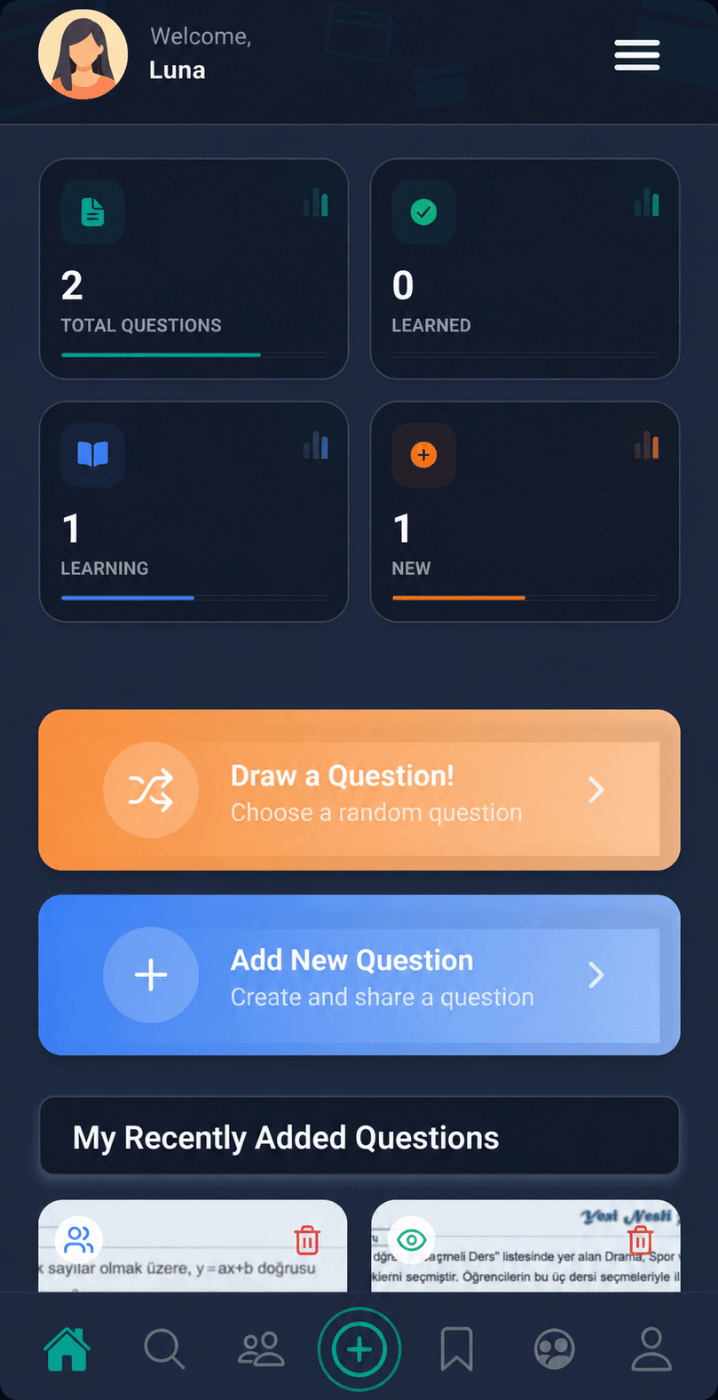 Save Your Questions
Solution Mode
Review Your Mistakes
Save Your Questions
Solution Mode
Review Your Mistakes
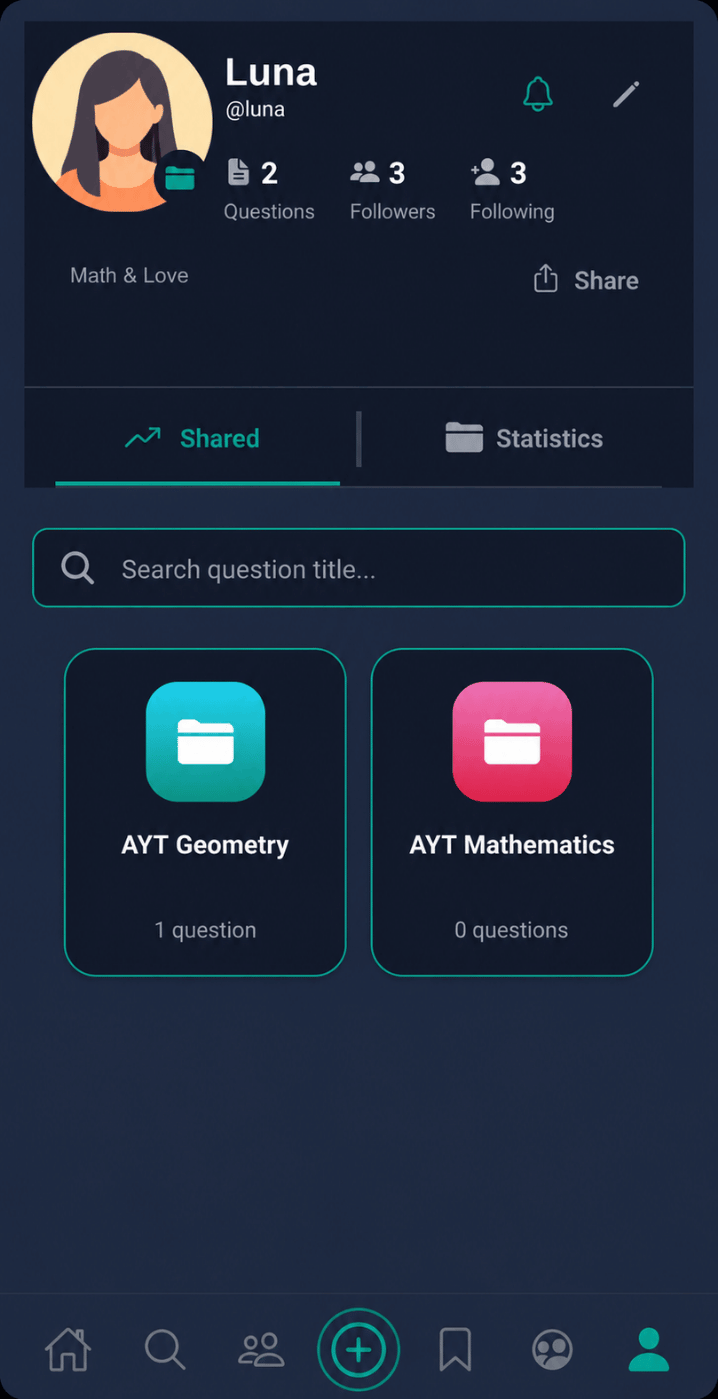 Organize Your Questions
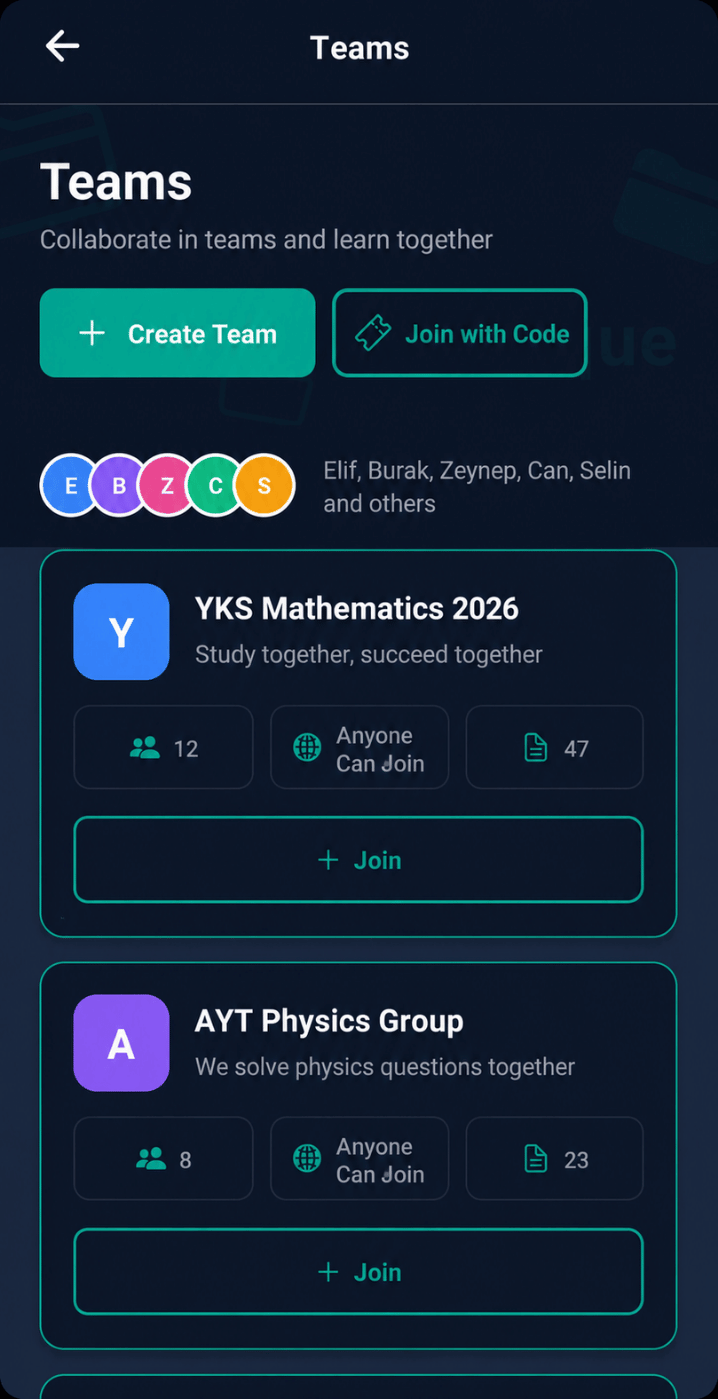 Share With Your Team
Never Lose an Important Question Again
Use Foldque to save missed, challenging or useful questions, keep question and solution images separately, organize them by subject and topic, review them later and track your progress. Check our download page for details.
DOWNLOAD FOLDQUE ON GOOGLE PLAY12. Frequently Asked Questions
When should I start keeping a mistake notebook?
It is best to start from the very beginning of your study process. The archive you build over time will be your most valuable resource as exams approach. But no matter when you start, regular review will always bring results.
How many questions should a question archive contain?
There is no specific limit. What matters is the quality of the questions, not the quantity. Instead of randomly adding every question, you should save ones that genuinely teach you something.
Is a paper or digital question archive more practical?
While paper notebooks feel nostalgic, cutting and pasting questions takes time and they are hard to carry. A digital question archive offers speed and practicality with fast camera capture, categorization, and separate solution storage.
Should I also add questions I answered correctly or liked?
Yes. You can definitely add questions you solved correctly but took too long, guessed correctly, found an elegant solution to, or simply want to review again before an exam.
Why keep question and solution images separately?
Accidentally seeing the answer while re-solving a question makes your brain's learning and recall process passive. By keeping them separate, you can apply your own effort first and then compare it with the correct solution.
How often should I review my mistakes?
You can set weekly or monthly intervals based on your study habits and the difficulty of the questions. The important thing is to prevent any question in your archive from being forgotten for weeks.
Does Foldque provide pre-made questions?
No, Foldque is not a question bank. It is a completely personalized digital archive application built from the questions you encounter and struggle with.